26. Remove Duplicates from Sorted Array
On LeetCode ->Problem
Given a sorted list nums, remove duplicates in-place so each value appears once, keep order, and return the count of unique values.
Example:
Key trick
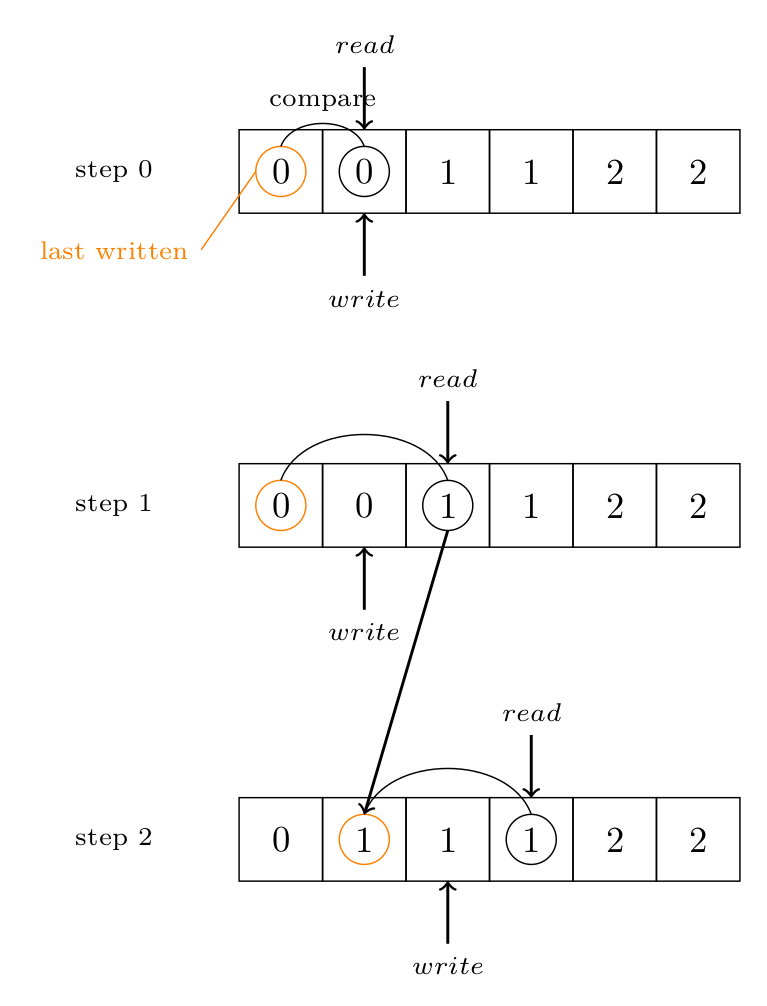
Use two pointers.
- One pointer reads every value.
- One pointer writes the next unique value.
- Because the array is already sorted, a value is new iff it differs from the previous kept value.
Trap
- Using extra structures like
Counter,set, or a new list. - Forgetting the operation must be in-place.
- Comparing with the previous original element instead of the previous kept unique element.
- Mishandling edge cases like a single-element array.
Why is it interesting?
It tests a core interview pattern:
- in-place array compaction
- two pointers
- exploiting sorted input to get \(O(n)\) time and \(O(1)\) extra space
Python solution
class Solution:
    def removeDuplicates(self, nums: list[int]) -> int:
        n = len(nums)
        w = 1 # Write index of the next unique value.

        for r in range(1, n):
            # Since nums is sorted, a new unique value differs
            # from the last kept one.
            if nums[r] != nums[w - 1]:
                nums[w] = nums[r]
                w += 1

        return w
Library alternative:
- None worth using here.
- Built-ins like
setorCounterbreak the intended \(O(1)\) extra space requirement.
Comment on my solution
Your solution works for the shown examples, but it misses the main constraint.
Counter(nums)uses extra memory, so it is not in-place in the interview sense.sorted(c.keys())is unnecessary because the input is already sorted.- Time is still fine here, but space should be \(O(1)\), not \(O(n)\).
- This problem is meant to be solved by overwriting the array with a write pointer.
## Solution

from collections import Counter


class Solution:
    def removeDuplicates(self, nums: list[int]) -> int:
        c = Counter(nums)  # Counter({1: 2, 2: 1})
        uniq_numbers = sorted(c.keys())  # [1, 2]
        for idx, val in enumerate(uniq_numbers):
            nums[idx] = val
        return len(uniq_numbers)


## Test

import pytest


@pytest.mark.parametrize(
    "nums,expectedNums",
    [([1, 1, 2], [1, 2]), ([0, 0, 1, 1, 1, 2, 2, 3, 3, 4], [0, 1, 2, 3, 4])],
)
def test_remove_duplicate(nums, expectedNums):
    solution = Solution()

    k = solution.removeDuplicates(nums)

    assert k == len(expectedNums)
    for i in range(k):
        assert nums[i] == expectedNums[i]